Microsoft Clarity now separates branded and non-branded AI citations inside its Citations dashboard, and the change matters more than a routine feature note suggests. Since the update went live on August 3, 2026, you can finally see whether an AI assistant quoted your site because someone asked about your brand by name, or because you earned a spot answering a broad, category-level question. Those are two very different kinds of visibility, and treating them as one number has hidden real gaps for years.
This guide breaks down what the split shows, how Clarity’s Share of Authority works, and how to turn each segment into a concrete next step. You will also learn where the data stops, so you do not read more into a citation than it can support.
Key Takeaways
- Two segments, two meanings. Branded citations track demand for your name; non-branded citations track whether you win category-level questions.
- Share of Authority is now split. Clarity reports your share of citations separately for branded and non-branded queries, calculated daily.
- Citations are not clicks. A citation is a mention inside an AI answer, not a visit or a conversion, so track the three separately.
- Weak non-branded means a content gap. Thin category coverage is the usual cause, and it is the most fixable.
- Grounding queries differ from user prompts, so read intent carefully and set monthly baselines.
What Changed In Microsoft Clarity
Clarity added three things to the AI Citations view. Individual queries now carry a branded or non-branded label. The Share of Authority card breaks its result out by those two types instead of blending them. And a filter lets you isolate either segment so you can study one at a time. The feature sits in the free tier with no traffic cap, which puts brand-versus-category measurement in reach for teams that never had it.
The short version: Clarity stopped asking only “how often does AI cite you” and started asking “why.” That single distinction turns a vanity count into a planning tool.
What Do Branded And Non-Branded AI Citations Tell You?
The value of separating branded and non-branded AI citations comes down to intent. Each segment answers a different question about your presence in AI answers.
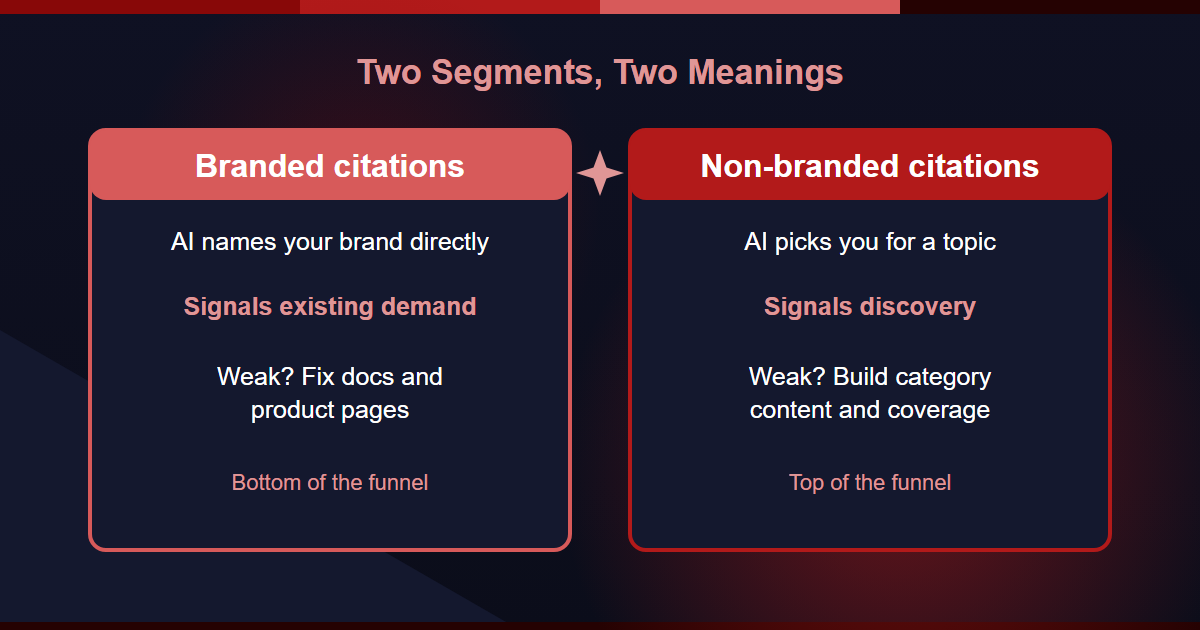
- Branded citations fire when the AI references your company or product directly. High branded volume means people and models already know your name, and your owned documentation is strong enough to be quoted.
- Non-branded citations fire when a user asks a general question and the AI picks your content as a source without being pointed at you. This is top-of-funnel discovery, the segment that grows an audience that has never heard of you.
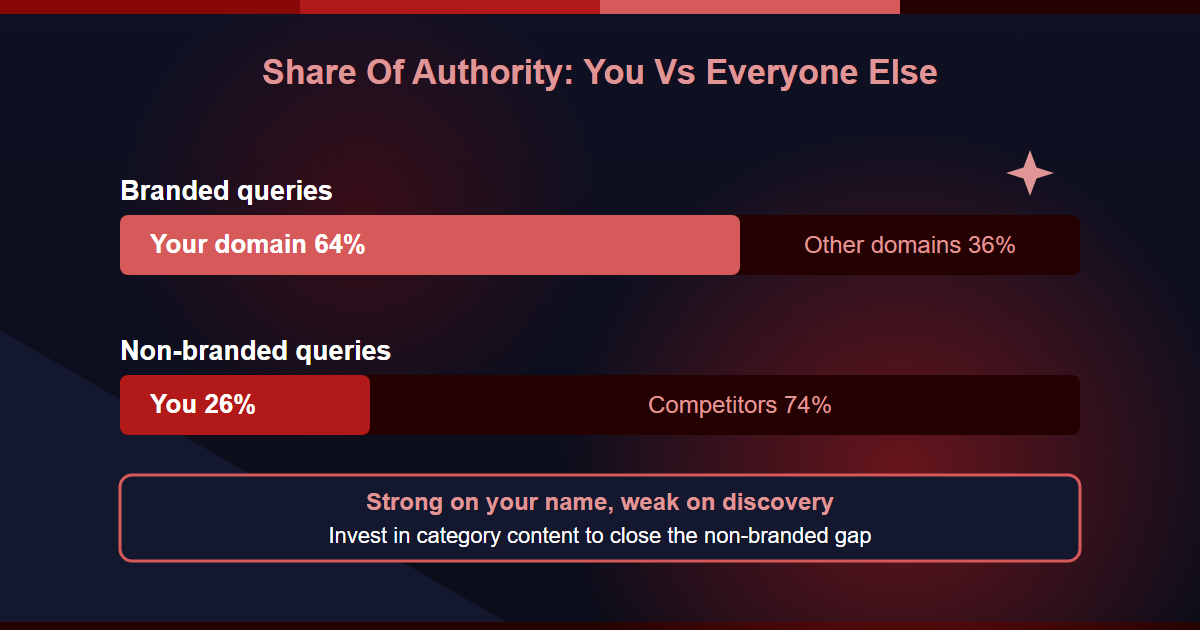
A brand can look healthy on total citations while its non-branded share sits near zero, which signals it wins on reputation but loses the discovery layer. That is exactly the audience served by learning how to get cited by AI search with specific writing.
How Share Of Authority Measures AI Visibility
Share of Authority is the percentage of citations that go to your domain versus every other domain cited within the same set of queries. Clarity calculates it daily, and now reports it once for branded queries and once for non-branded ones.
- Branded Share of Authority shows how firmly you own the conversation about yourself. A number well below 100% can mean review sites, forums, or competitors are answering questions about you before you do.
- Non-branded Share of Authority shows how often AI picks you over rivals for category topics. This is your true competitive scoreboard for discovery.
Because the metric only counts queries where your domain already appeared, a rising share on a shrinking query set is not the same as broad growth. Read share and raw volume together, the same discipline behind sound data integrity for SEO in AI search.
Why Citations Are Not Referral Traffic Or Conversions
A citation means an AI answer named your page as a source. It does not mean a person clicked, and it does not mean anyone bought. Conflating the three is the fastest way to misread the dashboard.
- Citations measure inclusion in the answer.
- AI referral traffic measures the visits that actually arrive from those surfaces.
- Conversions measure what those visits do once they land.
Track all three side by side. A jump in non-branded citations with flat referral traffic still has value, because appearing in the answer builds familiarity even when the user never clicks. Whether that familiarity sticks is its own question, one we cover in whether answer engines remember your brand.
A Simple AI Visibility Scorecard
You do not need a heavy dashboard to act on this. Build a monthly scorecard with a handful of columns and review it across your priority pages and topics.
| Metric | What it tells you | Act when |
|---|---|---|
| Branded citations | Demand for your name | Low despite known brand: fix docs and product pages |
| Non-branded citations | Category discovery | Low: build stronger topic content and third-party coverage |
| Branded Share of Authority | Ownership of your own story | Others outrank you on your name: reinforce owned pages |
| Non-branded Share of Authority | Competitive position | Falling: invest where rivals are winning |
| AI referral traffic | Real visits from AI | Flat while citations rise: sharpen titles and answers |
Set a baseline in month one, then watch direction more than any single day’s figure.
Understand The Limits Of Clarity’s Data
The split is useful, but it is not omniscient. Keep three limits in mind before you draw conclusions.
- Grounding queries are not user prompts. The query the model runs to gather sources can differ from what the person actually typed, so avoid firm claims about user intent.
- Share depends on the query set. The metric only reflects queries where you already showed up, not the full universe of relevant questions.
- One tool, one view. Clarity sees what it can measure. Pair it with checks in ChatGPT, Copilot, and Google AI Overviews for a fuller picture, the kind of cross-surface habit behind turning low trust in AI search into an SEO opportunity.
You can read the official rollout on the Microsoft Clarity blog, and explore the tool itself at clarity.microsoft.com.
Frequently Asked Questions
What is the difference between branded and non-branded AI citations?
Branded citations happen when an AI references your company or product by name. Non-branded citations happen when the AI picks your content to answer a general, category-level question without being pointed at you. Branded reflects existing demand; non-branded reflects discovery.
What does Share of Authority measure in Microsoft Clarity?
Share of Authority is the percentage of citations that go to your domain compared with all other domains cited for the same queries. Clarity calculates it daily and now reports it separately for branded and non-branded queries.
Do AI citations mean people are visiting my site?
No. A citation is a mention inside an AI answer, not a click. Track citations, AI referral traffic, and conversions as three separate metrics so you do not overstate the impact of a rising citation count.
How should I act on weak non-branded visibility?
Weak non-branded citations usually point to thin category content. Publish stronger topic pages that answer the questions people ask before they know your brand, and earn credible third-party coverage on the same themes.
Is the branded and non-branded split free to use?
Yes. The feature lives in the Citations dashboard within Microsoft Clarity’s free tier, with no traffic limit, so any site with Clarity installed can use it.
Turn The Split Into A Plan
Separating branded and non-branded AI citations gives you something a single count never could: a reason behind the number. Read branded volume as demand for your name, read non-branded volume as your reach into fresh audiences, and use each Share of Authority figure to decide where the next piece of content should go. Set your baseline this month, watch the direction, and let the two segments point your AI visibility work at the gap that actually costs you customers.