When a client asks why organic traffic fell, the honest answer in 2026 is that the click moved, not the demand, and your report needs AI visibility metrics to prove it. AI Overviews and chatbots now answer many searches on the results page itself, so people find the brand without ever clicking through. Seer Interactive measured a 61% drop in click-through rate on queries that show an AI Overview between June 2024 and September 2025, and zero-click rates on those queries run as high as 80 to 83%. The traffic chart looks alarming; the underlying visibility often is not.
This guide gives you a calm, accurate story to tell clients and the four AI visibility metrics to report instead of defending a falling line. You will also learn why impressions and clicks split apart, and where to surface the new numbers so clients trust them.
Key Takeaways
- The click moved, not the brand. AI Overviews answer on the page, so visibility can hold while clicks fall.
- Report AI visibility metrics. Track visibility, position, citations, and sentiment across AI engines.
- Explain the Great Decoupling. Impressions can rise while clicks drop, and that split is the story.
- Citations pay off. Brands cited in AI Overviews earn more clicks, so being named is worth measuring.
- Put the data where clients look. Fold AI visibility into the same report they already read.
Why Is Organic Traffic Dropping In The First Place?
Your content did not suddenly get worse. The search results page changed. When Google shows an AI Overview, it often answers the question in full, and the user has no reason to click. That is a zero-click search, and on AI Overview queries it now dominates.
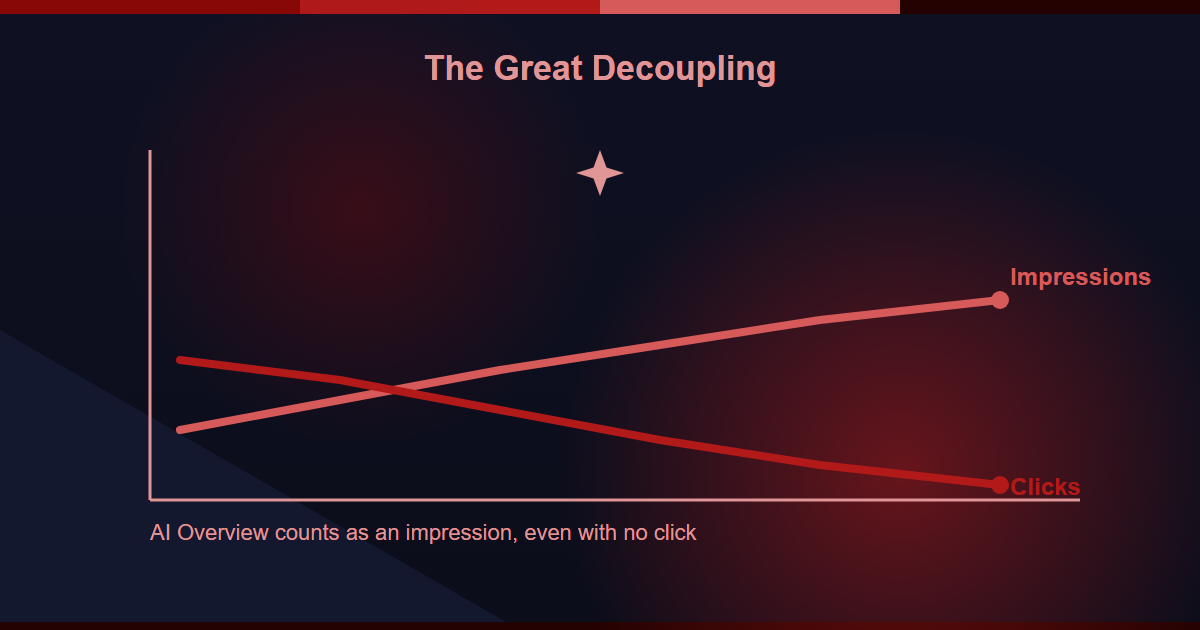
The effect compounds because Google still records an AI Overview appearance as an impression in Search Console. So impressions can climb while clicks fall, a split the industry calls the Great Decoupling. A dashboard built only on sessions reads that as failure, when the brand may actually be more visible than before. This is the same click erosion we cover in why AI search is causing click loss.
What Do Clients Actually Want From A Report?
Clients rarely care about raw sessions for their own sake. They care about conversions, qualified leads, and return on investment, and traffic was only ever a proxy for those. That distinction is your opening. When you reframe the conversation around outcomes and visibility, a dip in sessions stops being a crisis and becomes context.
Tell them the plain truth: more of their audience now meets the brand inside an AI answer, before any click. The job shifts from counting visits to proving presence at the moment of the question, a shift explained further in how AI search is changing SEO strategy.
What Are The AI Visibility Metrics To Report Instead?
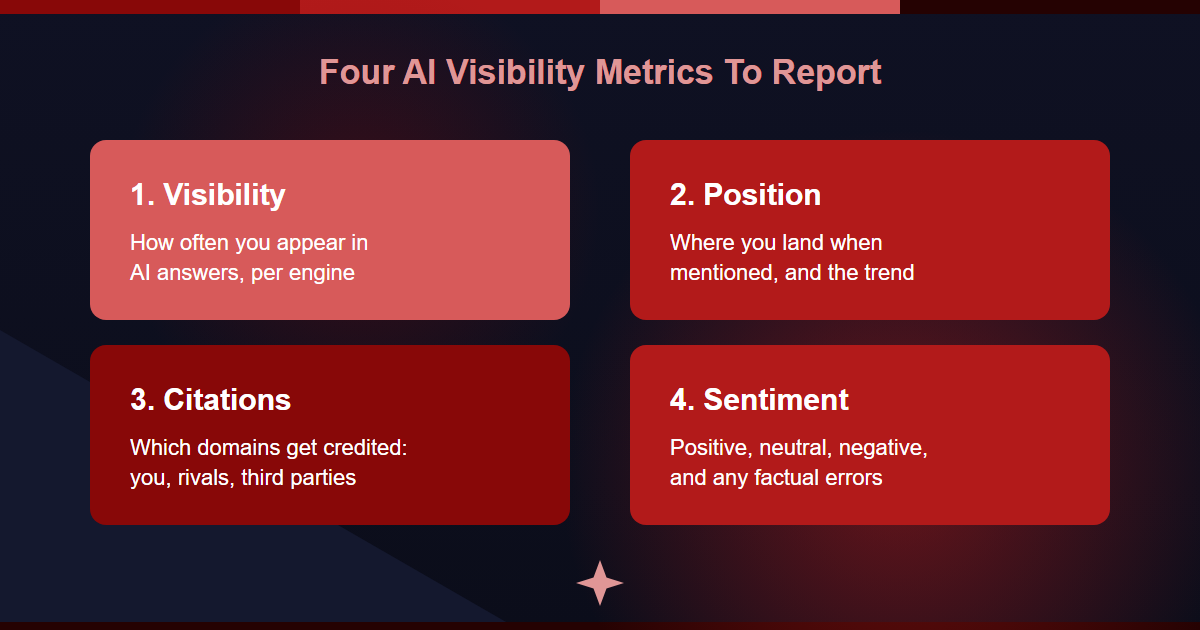
Four metrics replace the single traffic line. Together they show whether the brand appears, where it ranks, who gets credited, and how it is described across ChatGPT, Gemini, Perplexity, and Google’s AI answers.
- Visibility. Run 20 to 30 realistic buyer prompts each month and record how often the brand appears, as a percentage per engine.
- Position. Note where the brand lands when it is mentioned, first, mid, or last, and track the direction over time.
- Citations. Log which domains the AI cites as sources, and tag each as the client, a competitor, or a third party.
- Sentiment. Tag each mention positive, neutral, or negative, and flag any factual error the model repeats so you can correct the source.
Citations deserve special attention, because being named is not vanity. Brands cited in AI Overviews earn measurably more clicks, so a rising citation share is a leading indicator of recovery. Earning those mentions is the focus of how to get cited by AI search.
How Should You Frame The Conversation With Clients?
Lead with the shift, not the shortfall. Open the review by naming the change in how search works, then show the visibility numbers before the traffic ones. A short script helps:
- Name the change. “Search now answers many questions on the page, so fewer people click even when they find you.”
- Show presence. “Here is how often you appear in AI answers this month, and how that trend is moving.”
- Tie to outcomes. “Your conversions and lead quality held, which is what the traffic number was standing in for.”
- State the plan. “We are growing citations and correcting how the AI describes you, because that is what wins the next click.”
Framed this way, a traffic dip becomes evidence of a market shift you are already managing, not a miss. It also matches the broader move away from click-only thinking in what ChatGPT means for traditional search traffic.
Where To Put AI Visibility In The Report
Do not bolt the new numbers onto a separate slide no one opens. Place AI visibility beside the metrics clients already read, right next to conversions and leads, so the story reads as one picture. Google added AI search reporting to Search Console in mid-2025, which gives you a native starting point for the click side of the split. Pair that with a monthly prompt test across the major assistants, and you have a repeatable view that survives the next algorithm change.
For the underlying research, review Seer Interactive’s click-through-rate analysis and Google’s own documentation on AI features in Search.
Frequently Asked Questions
Why did my organic traffic drop if rankings held?
AI Overviews answer many queries on the results page, so users get what they need without clicking. Your ranking can hold while clicks fall, because the click became unnecessary. That is a zero-click search, not a ranking loss.
What are AI visibility metrics?
AI visibility metrics measure how a brand appears inside AI answers rather than how many people click a link. The core four are visibility (how often you appear), position (where you appear), citations (which sources get credited), and sentiment (how you are described).
What is the Great Decoupling?
The Great Decoupling is the split between impressions and clicks in Search Console. An AI Overview appearance counts as an impression, so impressions can rise while clicks fall, which makes traffic-only reports misleading.
Do AI citations actually help traffic?
Yes. Brands cited as sources in AI Overviews tend to earn more clicks than those left out, so tracking and growing your citation share is a practical way to recover visits and prove progress.
How do I track AI visibility each month?
Run a fixed set of 20 to 30 realistic buyer prompts across ChatGPT, Gemini, Perplexity, and Google’s AI answers, then record appearance rate, position, citations, and sentiment. Repeat monthly and report the trend, not just the snapshot.
Change The Metric, Keep The Trust
A falling traffic line is not proof your SEO stopped working; it is proof the search page changed. Show clients the AI visibility metrics that reflect how people actually find them now, tie those numbers to the conversions and leads they care about, and put the data where they already look. Do that, and a scary chart becomes a clear story: the audience still finds the brand, the click just moved, and you are already winning the new one.