
Decision distance is the gap between the motivations that actually drive a buyer’s choice and the messages your brand puts in front of them. It is the metric most SEO teams still do not track, and AI search has turned that blind spot into a real cost. Clicks, impressions, rankings, and click-through rate all measure the outcome of a decision someone already made. None of them tell you why that person chose, hesitated, or walked away. As large language models answer questions before a click ever happens, the winners are the brands whose message sits closest to the reason behind the search.
This guide explains what decision distance means, why traditional metrics fall short in the age of AI, and how to measure and shrink the gap in four practical steps, even without a data science team.
Key Takeaways
- Decision distance measures motivation, not outcome. It scores how far your messaging sits from the drivers behind a real buying decision.
- Traditional metrics lag. Clicks, rankings, and CTR report decisions already made, so they miss the why.
- AI shortens the journey. LLMs synthesize answers before the click, so alignment with intent matters more than position.
- Drivers come in three types. Functional, emotional, and social motivations shape most choices.
- You can measure it in four steps. Find the drivers, score your messaging, compare, then close the gap.
Why Traditional SEO Metrics Fall Short In The Age Of AI
Rankings and traffic became the language of SEO because, for two decades, a click was the decision. Someone searched, compared a page of blue links, and chose. Those metrics counted the choice as it happened.
AI search broke that chain. An AI Overview or a chatbot reads dozens of sources and hands back a synthesized answer, so the user often decides inside the answer, not on your page. Your impression may never become a click, and your click may never become the moment of choice. The metric that still works is the one that asks a different question: how closely does your message match the motivation that started the search? That is where the focus on search intent over keyword volume pays off.
What Is Decision Distance?
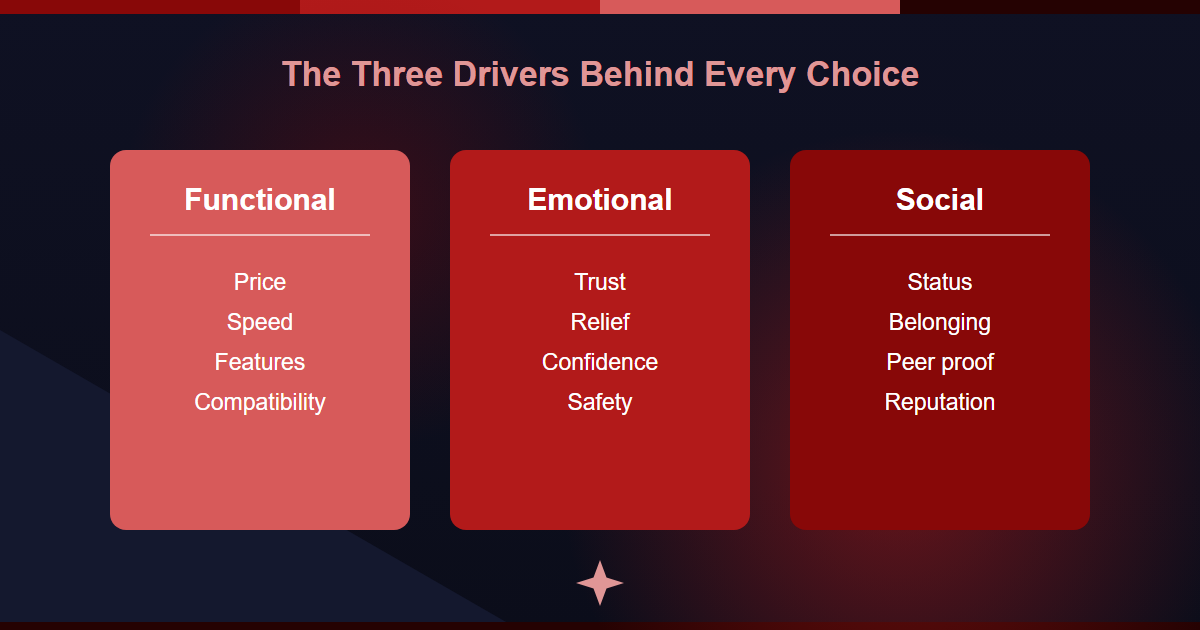
Every decision rests on a mix of drivers. Some are functional, such as price, speed, or a specific feature. Some are emotional, such as trust, relief, or confidence. Some are social, such as status or the reassurance of what others chose. Decision distance scores the gap between the drivers your audience cares about and the drivers your content actually speaks to.
Picture two profiles side by side. One shows what your buyers weigh most heavily. The other shows what your pages emphasize. When those profiles line up, the distance is short and people move forward. When your content leans on features while your buyers are weighing trust, the distance is wide, and no ranking gain will close it. Feeding clear, verifiable signals into that alignment is the same discipline behind strong data integrity for SEO in AI search.
How Do You Measure Decision Distance?
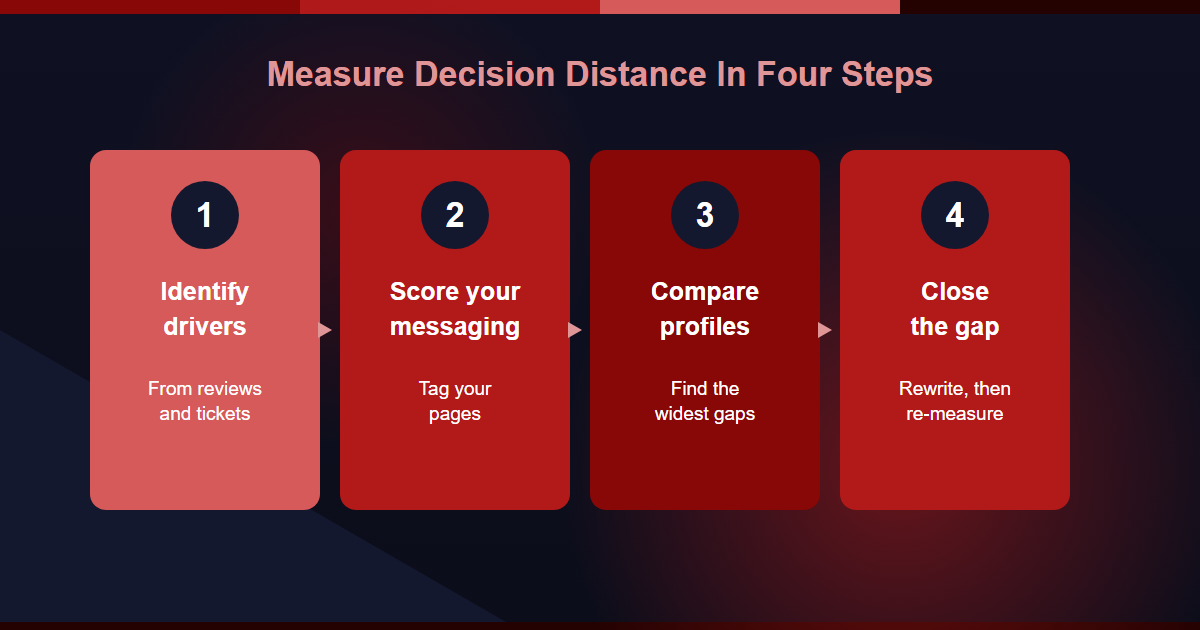
You do not need a machine learning pipeline to start. The logic works with careful reading and a simple scoring sheet, and you can automate it later. Follow four steps.
1. Identify The Decision Drivers
Pull the real language of your audience from reviews, sales call notes, support tickets, and community threads. Tag each phrase as functional, emotional, or social, then tally which drivers appear most. This gives you the audience profile.
2. Score Your Own Messaging
Run the same tagging across your landing pages, product copy, and top articles. Now you have a brand profile built from the same driver categories, ready to compare against the audience one.
3. Compare The Two Profiles
Line the profiles up driver by driver. The widest gaps are your decision distance. A buyer profile heavy on trust and social proof, met by pages heavy on specifications, points to a clear and fixable mismatch.
4. Close The Gap
Rewrite and restructure toward the underweighted drivers. Add the proof, the reassurance, or the outcome your audience actually asks for, then re-measure. Content built to answer the real motivation also earns citations, which ties directly into how to get cited by AI search.
The Three Drivers Behind Most Decisions
Sorting motivations into three buckets keeps the analysis honest and repeatable. Most buying choices draw on all three at once, in different proportions by stage.
| Driver type | What it sounds like | Content that closes the gap |
|---|---|---|
| Functional | Price, speed, features, compatibility | Clear specs, comparisons, pricing pages |
| Emotional | Trust, relief, confidence, safety | Guarantees, case studies, transparent process |
| Social | Status, belonging, what peers chose | Reviews, client logos, community proof |
Early-stage searches often lean emotional and social as people build confidence, while late-stage searches turn functional as they compare details. Mapping drivers to stages is part of understanding how AI search is changing SEO strategy.
Does Decision Distance Replace Clicks And Rankings?
No. It sits beside them. Rankings and traffic still tell you whether people can find you, and they remain useful health checks. Decision distance adds the layer they never captured: whether the people who find you hear the thing that moves them. Read the two together. Strong visibility with a wide decision distance explains the classic problem of high traffic and weak conversion, and it tells you exactly where to aim the next revision.
For authoritative grounding on aligning content with what users actually need, review Google’s guidance on creating helpful, people-first content and the consumer-journey research on how people actually decide.
Frequently Asked Questions
What is decision distance in SEO?
Decision distance is the gap between the motivations that drive a buyer’s decision and the messages a brand communicates across the customer journey. A short distance means your content speaks to what people actually weigh; a wide distance means it does not.
Why do clicks and rankings fail in the age of AI?
Clicks and rankings record decisions that already happened. Because AI search synthesizes answers before a click, the decision often forms inside the AI answer, so these metrics miss the motivation that shaped the choice.
How do I measure decision distance without a data team?
Read your audience’s own words from reviews and support tickets, tag each as a functional, emotional, or social driver, tag your own pages the same way, then compare the two profiles. The widest gaps are your decision distance. You can automate the scoring later.
What are the three types of decision drivers?
Functional drivers cover price, speed, and features. Emotional drivers cover trust, relief, and confidence. Social drivers cover status and what peers chose. Most decisions blend all three in different proportions.
Does decision distance replace traditional SEO metrics?
No. It complements them. Keep tracking rankings and traffic to confirm visibility, and add decision distance to check whether your message matches intent. Reading them together shows why traffic sometimes fails to convert.
Close The Distance, Not Just The Rank
SEO in the age of AI rewards the brand that answers the real reason behind a search, not just the one that ranks for its words. Start by listening to how your audience describes the choice, score your own pages against those drivers, and rewrite toward the gaps you find. Keep your rankings dashboard, but add decision distance next to it, because the shortest path between a search and a customer is a message that already sounds like their reason to say yes.