
The link between AI content and Google rankings just got a lot clearer, and the answer is more nuanced than either side of the debate wants to admit. A fresh Ahrefs study of roughly 150,000 pages from the top 10 results of 100,000 searches found that heavily AI-flagged pages still rank throughout Google’s first page, even though pages with high AI detection scores tend to sit slightly lower. If you have been holding back on AI-assisted writing out of fear of a penalty, this data should change how you think. Here is what the numbers say, why flagged pages keep ranking, and how to use AI without hurting your visibility.
Key Takeaways
- Roughly 54.7% of top-3 results carry less than 20% AI-detected content, and 82.2% of top-3 pages score under 50% AI.
- Heavily AI-flagged pages still rank: pages scoring 80% or higher AI made up 8.4% of position-1 results and 11.7% of position-10 results.
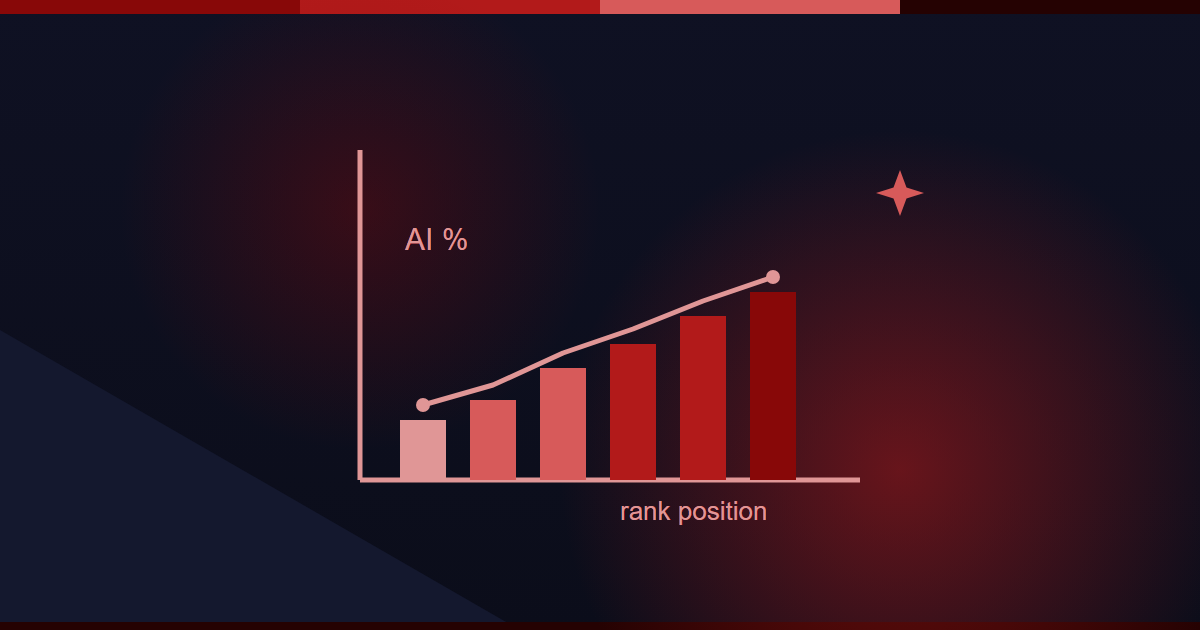
- Average AI detection scores rise gently down the page, from 27.1% at position 1 to 30.9% at position 10.
- Google does not penalize content for being AI-made. It rewards helpful, high-quality pages and demotes thin, unhelpful ones.
- Public AI detectors are unreliable and often flag human writing, so no detector reliably decides your Google rankings.
What the new AI content and Google rankings data shows
Ahrefs ran about 150,000 pages from the top 10 results of 100,000 searches through its AI detector in June 2026, then checked a separate sample of around 100,000 pages for indexing. The headline finding is simple. AI content and Google rankings do correlate, but weakly, and the correlation runs the opposite way from a hard penalty. Pages with higher AI scores rank a little lower on average, yet they still appear everywhere across the top 10.
The distribution tells the real story. More than half of top-3 results carry very little detectable AI, but fully AI-flagged pages are not shut out. Look at the spread across positions.
| Data point | Figure |
|---|---|
| Top-3 pages under 20% AI | 54.7% |
| Top-3 pages under 50% AI | 82.2% |
| Top-3 pages scored 100% AI | 5.3% |
| 80%+ AI at position 1 vs 10 | 8.4% vs 11.7% |
| Average AI score, position 1 vs 10 | 27.1% vs 30.9% |
| Indexing rate, under 20% AI vs 80%+ AI | 49.28% vs 40.35% |
You can review the full methodology in Ahrefs’ study on AI content and search. The pattern is consistent: a mild slope, not a cliff.
Does Google penalize AI content?
No. Google does not penalize content simply because a machine helped write it. It targets low-quality, unhelpful pages, whether a person or a model produced them. That position matches Google’s own guidance on AI-generated content, which rewards helpful, people-first content regardless of how it was created.

This distinction matters because it shifts your focus to the right lever. A thin AI article that repeats what everyone else says will struggle, just like a thin human article. A well-researched, genuinely useful page performs, even if you drafted parts of it with AI. The quality bar did not move. The tool you use to reach it did. Our guide to how AI search is changing SEO strategy for service businesses walks through what that quality bar looks like in practice.
Why do heavily AI-flagged pages still rank?
Several reasons explain why flagged pages hold their spots. First, Google evaluates helpfulness, expertise, and how well a page satisfies intent, not a hidden AI percentage. Second, plenty of strong pages use AI for a first draft, then add original research, expert review, and real examples that lift quality. Third, detection scores measure surface patterns, not accuracy or usefulness, so a flagged page can still be the best answer on the topic.
There is a small indexing gap worth noting. Pages under 20% AI were indexed at about 49.28%, while pages over 80% AI reached about 40.35%. That gap suggests Google indexes slightly fewer very AI-heavy pages, likely because mass-produced AI content skews thin. The takeaway is not to hide AI use. It is to make sure anything you publish earns its place. Trust signals help here, which is why we cover the upside of low trust in AI search as your next SEO opportunity.
Are AI content detectors reliable?
Not really. Public AI detectors frequently flag human-written text as machine-made and clear obvious AI drafts as human. Google has never confirmed any AI detector as a ranking signal, and the company has said patterns matter less than quality. So you should not treat a detector score as a verdict on your rankings. Use detectors as a rough editing prompt, not a compliance gate. If a page reads generic, fix the substance rather than chasing a lower score.
What this means for your SEO strategy
The practical response to the AI content and Google rankings data is steady, not dramatic. Keep using AI to move faster, and invest the time you save into the parts that make a page worth ranking.
- Lead with substance. Add original data, first-hand experience, and specific examples that no model can invent for you.
- Edit like an expert. Fact-check every claim, cut filler, and rewrite generic passages in a real voice.
- Match search intent. Answer the actual question fully and early, then support it with depth so AI systems and readers both trust the page. This is also the surest path to getting cited by AI search.
- Fix technical gaps. Make sure pages are crawlable and fast so quality content can be found. Our piece on how technical SEO problems stop websites from getting leads covers the basics.
- Avoid mass production. Publishing hundreds of near-identical AI pages is the pattern that actually invites trouble.
Frequently asked questions
Can AI content rank on Google in 2026?
Yes. The 2026 data shows AI-assisted and even fully AI-flagged pages ranking across Google’s top 10. Ranking depends on quality and helpfulness, not on whether AI helped write the page.
Does a high AI detector score hurt my rankings?
Not directly. Average AI scores rise only slightly down the page, from 27.1% at position 1 to 30.9% at position 10. Detectors are also unreliable, and Google has not confirmed any of them as a ranking signal.
Why are fewer AI-heavy pages indexed?
Very AI-heavy pages were indexed at about 40.35% versus 49.28% for low-AI pages. The likely reason is that mass-produced AI content tends to be thin, and Google indexes fewer thin pages, not that it targets AI itself.
How do I use AI without hurting SEO?
Use AI for drafting and structure, then add original research, expert review, and specific examples. Match intent, keep pages technically sound, and avoid publishing large volumes of near-duplicate content.
The bottom line
The relationship between AI content and Google rankings comes down to one rule that has not changed: quality wins. Google is not hunting for AI text to punish it. It is doing what it has always done, rewarding pages that help people and demoting pages that waste their time. Use AI as a tool, hold every page to a real standard, and your rankings will reflect the value you deliver, not the method you used to create it.