
If you want to remove negative content from Google, the clock now runs faster than it used to. A single unflattering page no longer just sits on page two where few people look. Google AI Overviews and assistants like ChatGPT and Perplexity read that same page, summarize it, and repeat the claim to people who never scroll a list of blue links. So the real goal in 2026 is not only to push a result down. It is to cut off the source the AI is quoting.
This guide gives you a straight decision path. You will learn the difference between removal, deindexing, and suppression, which content types you can actually take down, how to handle news articles, court records, data brokers, and Reddit threads, and how to confirm the fix held across both Google and AI answers.
Key Takeaways
- Source removal beats deindexing. A page hidden from Google can still be crawled and quoted by AI systems. A page deleted at the source cannot.
- Match the tactic to the content type. News, court records, data brokers, and forum threads each need a different route.
- Removal, deindexing, and suppression are not the same thing. Only removal is permanent.
- Verify across AI surfaces. Check Google AI Overviews, ChatGPT, and Perplexity, not just the classic results page.
- Build positive signals in parallel. Strong owned profiles and clear structured data shape what AI repeats about you.
Removal, Deindexing, Or Suppression: Which One Do You Need?
People use these three words as if they mean the same result. They do not, and the difference decides your whole plan.
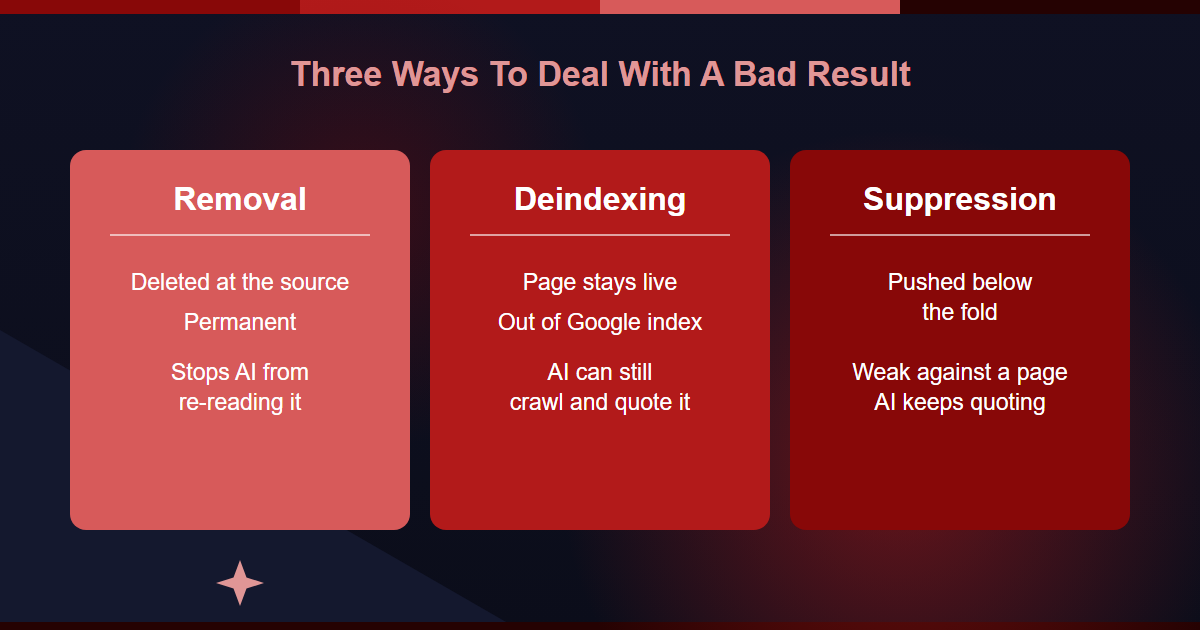
- Removal takes the content off its source page for good. The publisher unpublishes it or a court orders it gone. This is the only permanent fix, and it is the only one that stops AI models from re-reading the page later.
- Deindexing keeps the page live but pulls it out of Google’s index. The URL still exists on the open web, so an answer engine crawling that domain can still find and cite it.
- Suppression leaves the page in place and pushes it below the fold with stronger positive content. Good for opinions you cannot delete, weak against a page an AI keeps quoting.
Before you pick a route, answer three quick questions about the page. Is it still live? Does it contain a specific factual error, not just a fact you dislike? Is a court order, case dismissal, or expungement attached to it? Your answers point you straight to the right category below.
How To Remove A Negative News Article From Google
News sites almost never delete a story on request, and Google will not remove a lawful, accurate article from its index just because it hurts. So aim at the parts you can actually move.
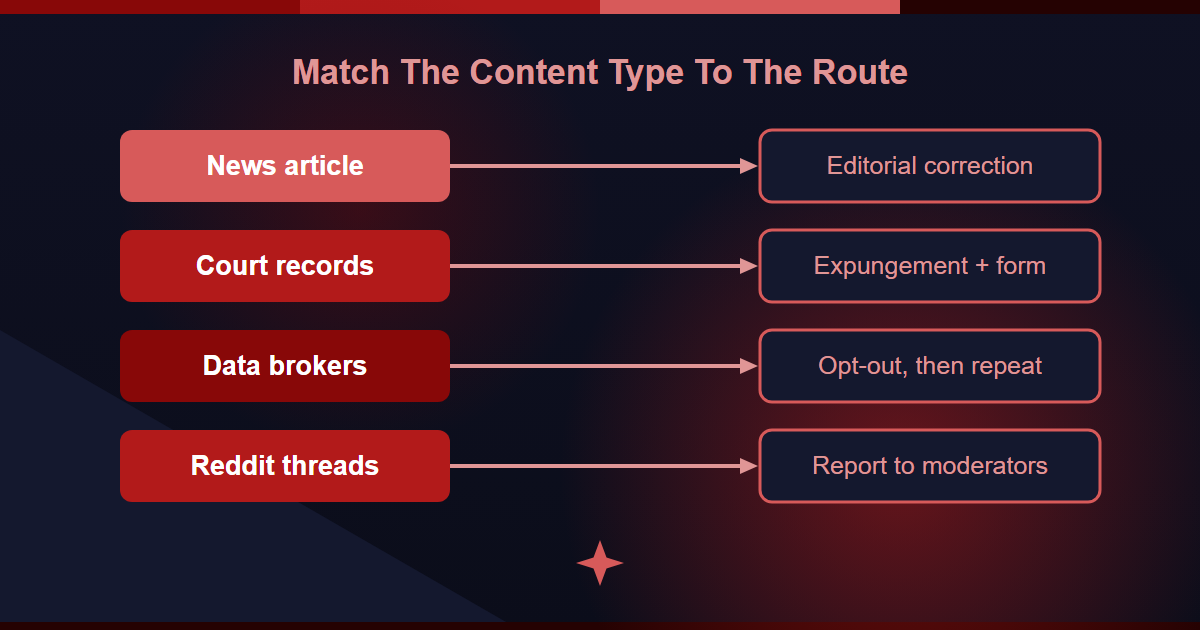
- Correct a real error. If the piece states something false and checkable, contact the editor with evidence and request a correction or an unpublish. Editorial corrections are the cleanest win because they change the source itself.
- Chase the syndicated copies. Wire stories get republished across dozens of sites. Removing the original does little if ten mirrors still rank, so track and address each copy.
- Use legal grounds when they exist. A retraction after a settlement, a defamation ruling, or a copyright claim under the DMCA can force a takedown that a polite email cannot.
When the facts are accurate and simply unflattering, removal is off the table. That is when you switch to building and promoting stronger owned assets, the same discipline behind getting cited by AI search with specific writing.
How To Remove Court Records And Mugshots From Google
Mugshots and court records sit in a category of their own because the law often works in your favor. Many states now cap or ban the fees mugshot sites charge to take an image down, and several require removal once a case is expunged or sealed.
- Confirm the legal status first. Secure the expungement, dismissal, or sealing order before you send any takedown request, because that document is your leverage.
- Send the record with the request. Publishers and Google both respond faster when you attach the court paperwork rather than describe it.
- Request Google removal for sealed records. Google offers dedicated forms to remove personal information and content tied to expunged cases from Search.
How To Remove Personal Information From Data Brokers
Data broker profiles feed a surprising share of what AI assistants say about a person, and they resurface constantly. Treat this as ongoing maintenance, not a one-time task.
- Opt out at each broker. Every broker runs its own removal process. Work through them methodically and keep a record of what you submitted.
- Use batch tools where available. California residents can file batch deletion requests through the state DROP platform, which reaches many registered brokers at once. The state registry lists over 500 brokers, so a batch route saves real time.
- Recheck on a schedule. Brokers rebuild profiles from fresh data, so a listing you cleared in spring can reappear by autumn.
Consistent, accurate profiles across the web also protect you from being confused with someone else, a problem covered in our guide to closing the identity leak in AI search.
Can You Remove Reddit And Forum Threads From Google?
Google now surfaces a “Discussions and forums” module, and requests to address Reddit threads have climbed sharply as a result. You usually cannot delete a thread you did not create, but you have real levers.
- Report policy violations. Content that breaks a subreddit rule or Reddit’s sitewide policy can be reported and removed by the platform.
- Message the moderators. Contact the subreddit’s mod team and cite the specific rule the post breaks. Precise, calm requests land better than broad complaints.
- Handle the downstream copies. Threads get scraped and mirrored on other sites, so clearing the Reddit original may not clear every ranking version.
How To Verify A Removal Actually Worked
A page that vanishes from the classic results list can still live inside an AI answer. That gap is exactly why verification matters more than it used to, and why the AI era rewards source removal over a simple deindex.
- Test the AI surfaces. Run your branded queries in Google AI Overviews, ChatGPT, and Perplexity, then note which URLs each one cites.
- Refresh stale snippets. When a page changes but Google still shows the old text, use Google’s Outdated Content tool to prompt a refresh.
- Monitor on repeat. Re-run the same prompts monthly and log the citations, because answer engines update their sources over time.
When you remove negative content from Google at its true source, the assistants lose the page they were quoting, so verification here is what proves the fix reached the AI layer and not just the results list. Whether a cleaned-up mention truly stays gone depends on how these systems hold memory, a question we explore in whether answer engines remember your brand.
Build Positive Signals So AI Repeats The Right Story
Removal solves the immediate wound. Positive signals decide the long-term narrative an AI tells about you. When your own assets are clear, current, and well structured, models have better material to quote.
- Keep an accurate About page, Google Business Profile, and author bios that state who you are and what you do.
- Publish credible third-party coverage and profiles that reinforce your expertise, authority, and trust.
- Add structured data and schema markup so machines read your key facts without guessing.
Feeding clean, verifiable information into the ecosystem is the same principle behind strong data integrity for SEO in AI search. You can review the official routes for personal-data removal in Google’s Search removal help center, and California residents can act through the California Privacy Protection Agency.
Frequently Asked Questions
What is the difference between removing and suppressing negative content?
Removing content deletes it at the source so it no longer exists for anyone, including AI crawlers. Suppressing content leaves it live but pushes it below stronger positive results. Only removal is permanent, and only removal stops an answer engine from re-reading the page.
Can Google remove a negative but accurate news article?
Generally no. Google will not deindex a lawful, accurate article simply because it is unflattering. Your options are an editorial correction of a genuine error, a legal takedown where grounds exist, or suppression through better owned content.
Why do AI Overviews make negative content more urgent?
AI Overviews read pages that users rarely click and then repeat the claim inside a summary at the top of the page. That hands old, buried content a fresh and much larger audience, so acting early limits how widely it spreads.
Does deindexing a page hide it from ChatGPT and Perplexity?
Not reliably. Deindexing removes a URL from Google’s index, but the page stays live on the open web where other crawlers can reach it. To keep a page out of AI answers, remove it at the source.
How often should I check my results after a removal?
Recheck monthly. Data brokers rebuild profiles, syndicated copies resurface, and answer engines refresh their sources, so a one-time cleanup rarely holds without follow-up.
How long does it take to remove negative content from Google?
It varies by route. A publisher correction or a Google removal form can resolve in days to a few weeks, while data broker opt-outs and legal takedowns often run longer. Plan to remove negative content from Google as a project with follow-up checks, not a single click.
Act Before The Summary Hardens
The businesses and people who protect their names in 2026 are the ones who move fast and aim at the source, not just the ranking. Sort each piece into the right category, choose the removal, legal, or suppression route that fits, and confirm the result across Google and the major AI assistants. When you remove negative content from Google at its source and verify it everywhere the answer appears, you shape the story before it hardens. Do that, and you shape the story the search engines and the answer engines tell long before it hardens into a summary you cannot edit.